

Settler colonialism leaves its mark across all that it touches. In 2024, neighborhoods flooded across San Diego. A year later, we saw another clear example: California set ablaze. While the ultra-wealthy protect themselves through expensive measures, everyone else suffers the consequences of a warming planet.
“The jail was full of smoke. People were coughing, and the police weren’t saying much, but you could tell they were on edge too.”
— Krista Harmon
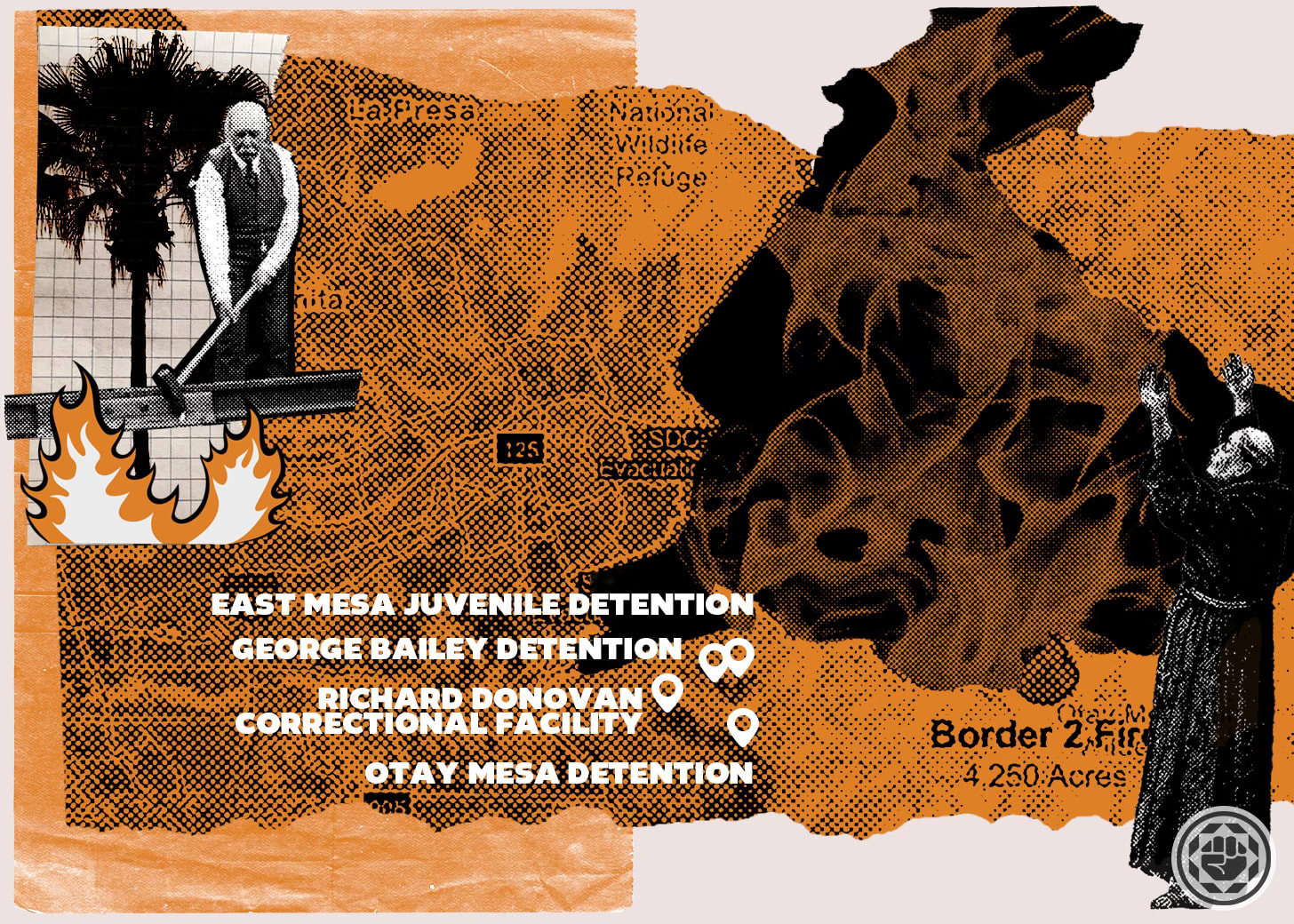
When the Border 2 Fire ignited in San Diego County on Jan 23, nearby communities were on alert. But inside George Bailey Detention Facility, the men locked in their cells weren’t given a choice. The fire never reached the jail, but the smoke did. And there was no escape.
“The jail was full of smoke. People were coughing, and the police weren’t saying much, but you could tell they were on edge too,” said Krista Harmon, whose husband is incarcerated there. “They didn’t give them masks. My husband said he felt trapped in a smoke-filled box.”
For days, movement inside the jail was restricted. The air thickened. Those with health conditions suffered.
“They should have been ahead of it,” Harmon said. “They should have had fans running before the smoke filled the facility. Instead, no one knew what was going on.”
Family members called, desperate for updates.
The response? Silence.
“This took a mental toll on them, too,” Harmon said, referring to the incarcerated men. “Not knowing if they would be okay, unable to talk to their families. It’s like they were just left in there to deal with it.”
Meanwhile, the San Diego County Sheriff’s Department assured the public everything was under control. “There is currently no danger to these facilities related to the Border 2 Fire,” they posted on Twitter (and replied to inquiries with the same messaging). Their official report noted that the jails would “shelter in place” but had an evacuation plan “if necessary.” No mention of the smoke. No mention of the people inside.
Harmon wasn’t surprised. “They always say it’s fine. It’s never fine,” she said.
This situation at Bailey is not an anomaly—it’s part of a pattern. Prisons across the U.S. are often built in toxic, unlivable places: fire zones, floodplains, and next to industrial waste sites; also on land that many deem too “remote” to be of use to anyone in polite society, like near an international border. In the case of Bailey, there are at least seven other detention centers in the immediate vicinity, some of which house children: CoreCivic Otay Mesa Detention Center (ICE), Richard J. Donovan Correctional Facility, East Mesa Juvenile Detention Facility, East Mesa Reentry Facility, East Mesa Adult Detention Center, Facility 8 Detention Facility, and Rock Mountain Detention Facility.
When disaster strikes, the people inside are left behind.
Two years ago, the Intergovernmental Panel on Climate Change released a report warning us that we are nearing the threshold of a 1.5 degrees Celsius rise in global temperatures. At this tipping point, we will lose significant portions of biodiversity. The sea level is expected to rise by 1.5 meters, and extreme heat will become up to three times more common in California. Without drastic change, these catastrophic events will continue to hit faster and harder.
With the introduction of settler colonialism, Europeans came to the Americas intending to control the land, the people, and the resources. This is not unique to the Americas. European settlers planted pine trees—at the same time as destroying Indigenous olive trees—near Jerusalem upon settlement, leading to the fires that spread across Palestine a few years prior.
While extreme heat and drought are becoming more common, California has historically been home to warm weather and lightning that could spark fires. The Kumeyaay Tipai stewarded the land from south of the San Diego River into Baja. According to Michael Connolly Miskwish, a member of the Campo Kumeyaay Nation, the Kumeyaay used prescribed fires to keep lands fertile and wildfire-resistant for generations. Settlers called it “primitive,” declaring that those who practiced it “should be shot.” They saw only the economic potential of timber and raising livestock, and mistook Kumeyaay land stewardship as natural abundance created by god for their settler fantasies..
Indigenous knowledge was ignored, and we are now left with overgrown, drought-stricken forests primed to explode.
That same settler logic doesn’t just shape how we manage land—it dictates where we build, who we protect, and who we leave behind. It’s why prisons, like George Bailey Detention Facility, sit in fire-prone areas, out of sight and out of mind.
The Sheriff’s Department’s Emergency Operations Manual details evacuation protocols. But what it does not include is how to address the slow violence of being trapped in a facility filled with smoke, with no protections, no medical attention, and no way to leave.
This is how the Land Back and abolition movements converge – as necessary responses to the same system. The same colonial structures that stole Kumeyaay land and criminalized cultural burns are the ones that use the land to build prisons and warehouse people deemed expendable by capitalism.
If we want a future where people aren’t left in smoke-filled boxes while officials tell us everything is fine, we must listen to those who have always known how to care for this land. And we need to dismantle the systems that refuse to.
Land Back and abolition aren’t separate conversations. They are the next steps.