

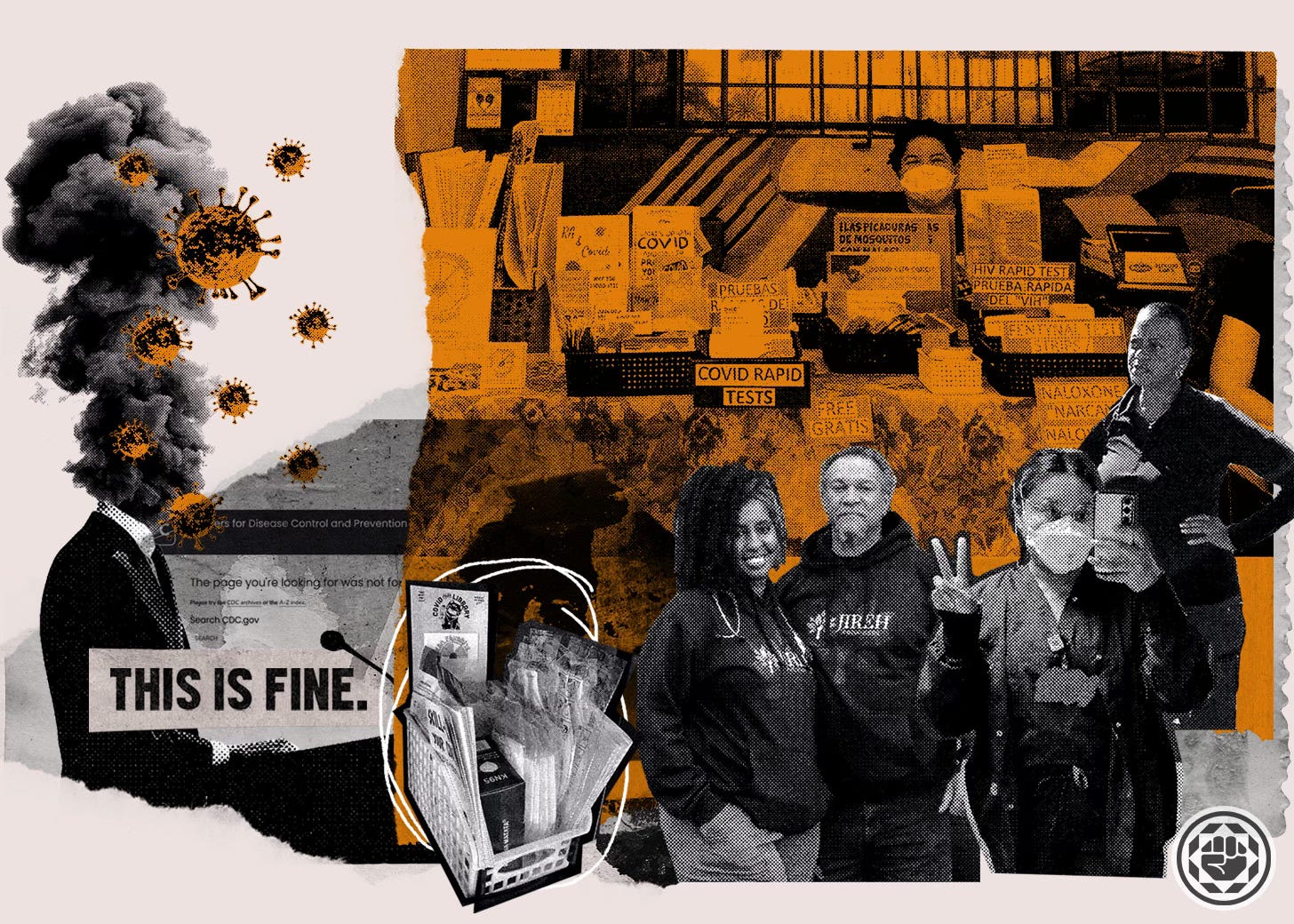
Public health is dead.
It’s a phrase heard often in COVID-conscious circles, but to poor and disabled communities of color, organized abandonment from the state is a core fixture of the so-called United States. The systems in place have always normalized our premature death and disablement, from using disease to declare the genocide of Indigenous Peoples “inevitable” to the still-prevalent myth in healthcare that Black people have a higher tolerance for pain. It has always been up to us to confront misinformation and advocate for our own survival. The COVID pandemic is no different.
COVID is not simply a cold. With every infection, there is a compounding risk of contracting Long COVID, a disease which can cause up to 200 symptoms like vertigo, brain fog, severe fatigue, and in some cases suicidal ideation and brain damage. Symptoms can be mild or completely debilitating, and last weeks, months, or even years.
“It took me four months to be able to speak without being short of breath,” said Samantha Williams. “I have to figure out how to reset my body just to get back to my baseline…You wonder, ‘Did I push myself so far this time that I won’t be able to recover?’”
Williams, Family Nurse Practitioner and CEO of JIREH Providers has been on the frontlines of mitigating COVID spread in Southeast San Diego. She experiences Long COVID flare ups for three days every month, and it’s sometimes so debilitating she rests in total darkness just to feel okay.
Studies from the National Institutes of Health show that Black and Latinx people are more likely to experience Long COVID symptoms, but less likely to be diagnosed than white people. In California state prisons, it is estimated that between 9 and 11 thousand incarcerated people have contracted Long COVID, predominantly Black and Indigenous Peoples – groups already disproportionately imprisoned. “Multi-racial,” Latinx, and Black people in the U.S. are reported to have above average rates of Long COVID, according to a study of U.S. Census data. And because data is often misdeclared for Indigenous Peoples, classifying people as “multi-racial” or “other” is likely undercounting the effects on Indigenous communities.
COVID exacerbates the long-standing emergencies of structural racism and organized abandonment, or what professor and Golden Gulag author Ruth Wilson Gilmore describes as, “the intentional disinvestment in communities which, in turn, creates opportunities for extraction, revenue generation, and carceral enforcement to fill the cracks of a compromised social infrastructure.”
“I don’t think the state has failed. I think the state has been operating as it intends to – which is to continue to embolden its power and disenfranchise the people.”
— Siobhán Eagen
“I don’t think the state has failed. I think the state has been operating as it intends to – which is to continue to embolden its power and disenfranchise the people,” said Siobhán Eagen, an Acjáchemem Nation and San Juan Capistrano Mission descendant. “And if the state cared about our health, then we would have land back. Our land is still unhealthy…You can’t have unhealthy air and unhealthy water, and expect to have healthy people.”
After Eagen watched their Indigenous and Queer uncle die of HIV/AIDS, they noticed the same patterns of organized abandonment with the COVID pandemic. This prompted them to start Fan Favorite, a group distributing free masks, tests, and air purifiers to communities all over San Diego.

Getting tested and treated for COVID and preventing infection in the first place are the best tools against Long COVID. In a Quebec study, the risk of Long COVID was shown to increase with each COVID infection – 13% after the first infection, 23% after the second, and 37% after the third.
Clarisa Bautista, another member of Fan Favorite, contracted Long COVID with their first infection. At just 23 years old, they are proof that the disease can affect everyone.
“When I was infected, I was really athletic. I’m a dancer, so I would consistently be doing exercise,” says Bautista. “And then after my infection, my stamina is completely gone.”
The federal Public Health Emergency for COVID was declared “over” in May 2023. Along with that came the end of Medicaid coverage for 10 million people. Black and Latinx enrollees were twice as likely as whites to lose coverage, and almost one year later, one-fourth of those who lost Medicaid were still uninsured. After California’s statewide moratorium on evictions expired in June 2022, eviction rates either returned to or surpassed pre-pandemic numbers. As of September 2023, 605,000 households in California owed $1.8 billion in back rent.
“[For] some people that didn’t have healthcare, these programs filled in the gap for them. Now, they don’t have health care still. They can’t afford it. They have to pay their rent…Now we’re back to square one,” says Suzanne Afflalo, M.D., one of the co-founders of the San Diego COVID-19 Equity Task Force. “If nothing more, they should have kept resources into the communities that…normally cannot afford access or treatment and care. We should have still had free COVID testing in the churches in the Black and Brown community.”
“We can’t continually catch a virus and be okay…we all share the air,” said Eagen. “There is no ‘you-do-you’ path to a pandemic. Public health is public.”
The Biden administration may have declared COVID over, but the rollout of safety precautions failed to keep up with scientific research from the start. As early as July 2020, researchers had shown COVID could travel through the air. Yet CDC recommendations focused on sanitizing groceries and maintaining a six foot distance, instead of clean air and high quality masks. It wasn’t until 2024 that the WHO updated its policy on COVID being airborne. If the need for clean air and masks had been publicized, the government would have been on the hook for retrofitting ventilation systems in public buildings across the country.
Even simply tracking the effects of racism on health are under attack. In January, data collected to track health disparities across race and gender were either amended or scrubbed from the CDC website to comply with an Executive Order. Funding to UCSD’s wastewater testing system, which monitored local levels of influenza and COVID, was also cut in April.
As we roll into the fifth year of the COVID pandemic, additional mass disabling threats like H5N1 (bird flu), influenza, and climate crisis loom over the horizon. Perhaps looking to the institutions that created these crises should no longer be the first line of defense.
“I pushed back on the County,” says Williams. “And just, you know, our whole system of how we so heavily promoted vaccinations and testing, and then as soon as it wasn’t important to them, it was like, ‘Well, I don’t know how you gonna get it no more, because Medi Cal is not covering it.’”
When someone in the community tests positive for COVID, Williams’ organization JIREH Providers offers a free telehealth visit, prescription pickup, groceries in partnership with My Brother’s Keeper and Project New Village, and a COVID Care Kit. Williams, Dr. Afflalo, and a mass of volunteers and health care workers organized vaccination and testing solely for Southeast San Diego that vaccinated 30,000 people in just one year.
“You got all of this funding being poured into local, state and federal for scenarios and situations that they themselves created, right…this organized abandonment, right? And we’re talking about from centuries ago to yesterday,” said Williams. “Then the money often doesn’t even get to those communities.”
By the time hazardous levels of lead and asbestos were detected in the air in the historically Black neighborhood of Altadena during the LA wildfires, it was self-funded and autonomous groups supplying residents with masks, not a government funded by millions in taxpayer dollars. Masks were in people’s hands on day one of the fires, thanks to local mask blocs prepared to protect people from COVID. Bautista also traveled to LA to help distribute masks.
“I think it’s just our experience with the government’s handling of COVID…and saying that, ‘It’s over!’ when it’s clearly not over,” said Bautista. “When disasters strike like these wildfires, the mask blocs were already prepared to give [personal protective equipment] PPE.”
By the time the city of LA started distributing masks on January 13, Mask Bloc LA had already distributed 43,000, Clean Air LA had arranged for the delivery of 180,000 masks, and DIY air purifier builds were set up across the city. This confirmed something COVID-conscious organizers have known all along: when resources are focused on those with the least access, it’s a mass benefit to all.