

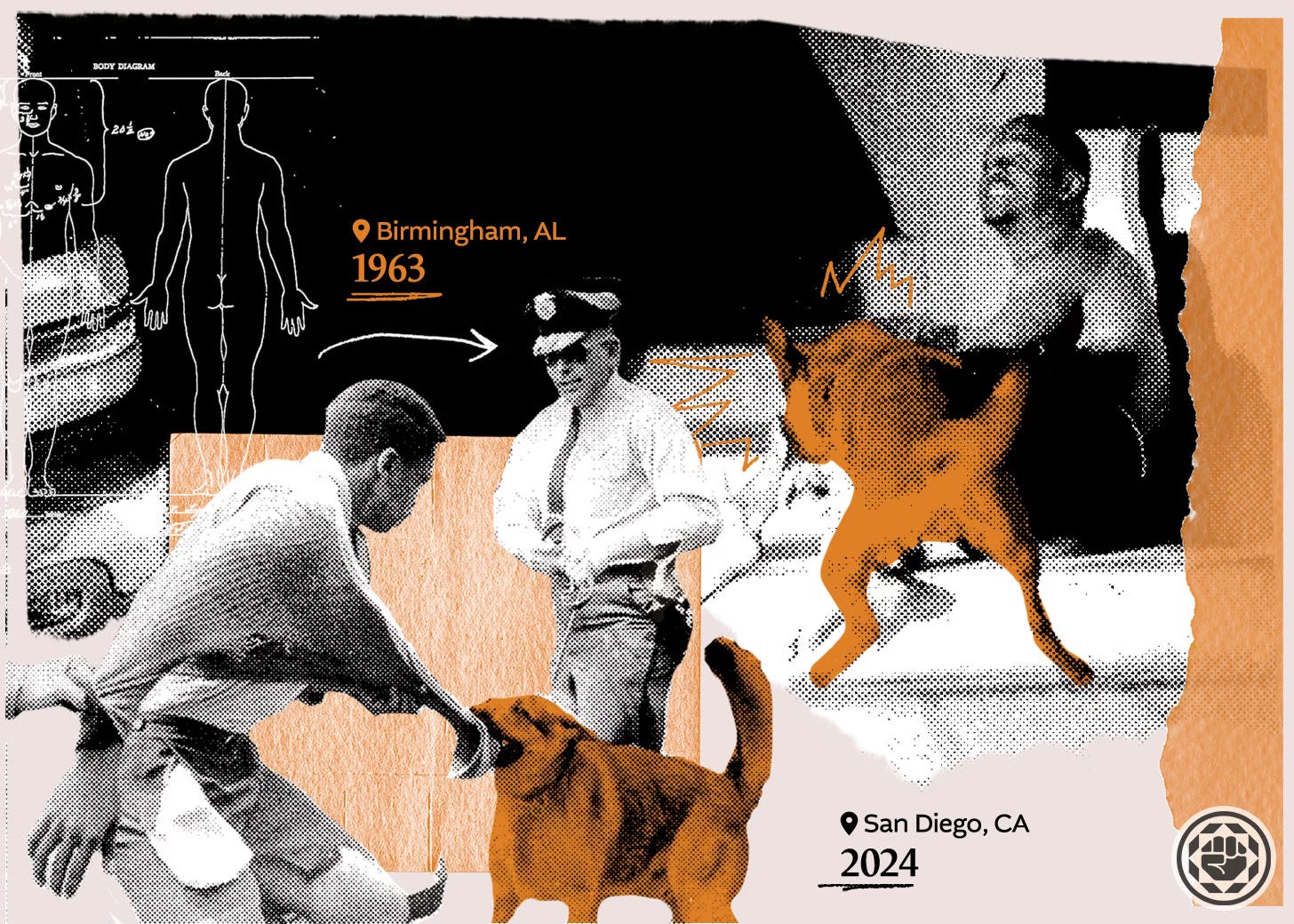
“The dog is the most potent, versatile weapon ever invented…You can’t shoot around corners, but dogs can go anywhere you direct them — like guided missiles. They never lost races.”
— Sgt. William H. Kerbe, Baltimore K9 Officer
Most people know the Thirteenth Amendment to the Constitution abolished slavery. While seemingly righteous on its face, allowing Congress to pass laws that eradicate the “badges and incidents of slavery,” a particular carve out in the amendment maintains the foundations of slavery through our criminal legal system.
The carve out, “except for punishment for a crime,” allows for disproportionate criminalization, over-policing, harsher sentencing, and the sometimes lifetime stripping of constitutional rights, ensuring that the remnants of slavery still very much exist for Black people in the U.S. One particular badge and incident of slavery that remains in police departments across the United States is the use of K9 units.
The use — and abuse — of K9 units to harass and attack Black community members is a direct historical derivative of chattel slavery, in which enslavers used hunting dogs to catch and attack enslaved people. The Fugitive Slave Act, infamously known as the Bloodhound Bill, federally legalized slave patrols’, commonly accompanied by hunting dogs, ability to seize slaves in free states.
Today, the use of K9s by the San Diego Police Department remains a prolific way to subdue Black residents. Between 2018 and 2024, of 214 dog bite incidents recorded by SDPD, 26 percent involved a Black person. Black residents make up less than 6 percent of San Diego’s population.
San Diego Police Department’s K9 Unit touts itself as being recognized as one of the best canine teams in the country. Yet video after video recorded by bystanders depict arguably unnecessary and unreasonable use of K9s to attack community members who seemingly pose no threat of imminent physical harm, such as against people experiencing homelessness or partygoers in the Gaslamp District.
One of the most recent and alarming examples is the case of Marcus Evans. In the late evening of October 24, 2024, police responded to a call at Evans’ home, alleging he was in possession of a firearm. Evans’ approximately 30-minute interaction with SDPD was caught on camera by a bystander and has since gone viral. The video shows Evans exiting his home dressed in only basketball shorts, no shirt, no shoes, nothing in his hands and no weapons in sight. Following police command, Evans exits his home with his hands up, and does a 360 degree turn to show officers he has no weapon on him. He sits down passively on a brick fence lining his front yard, hands visible at all times, making no sudden or rapid movements, and posing no active threat, either verbally or physically.
With no attempt by any of the multiple officers on the scene to approach or subdue Evans, police fire multiple rounds of extended range impact weapons and order a K9 to attack and maul Evans twice. Evans was subsequently arrested, no charges were filed, no weapon was ever found and he sustained injuries that required medical attention.
Evans has since filed a lawsuit against SDPD and formal complaints were filed against SDPD by community members and even by an SDPD officer.
The incident came to the attention of the Commission on Police Practices (CPP), an independent community oversight body of SDPD. Doug Case, chair of the CPP, described the incident as “disturbing” and says that he doesn’t think most community members recognize the impact of a dog bite. “A dog bite is very serious, very painful, and most likely requires surgery.” Case states that in his opinion, “deploying a police dog is a serious issue and second only to deploying a gun. There is no other painful ammunition” and this practice “demands greater scrutiny.”
While Evans’ case has spurred media attention and important public discussion, this is only one of many disturbing incidents of K9s attacking innocent people. In 2017 a video went viral of Korand Cheatum, in Downtown San Diego, handcuffed and on the ground while a K9 vigorously grips onto his arm and shakes back and forth as Cheatum screams in agony and bystanders yell at police officers for failing to intervene. Another terrifying incident occurred in 2021, when a police K9 saw a 5-year old girl jumping on a trampoline, hopped the fence and attempted to attack the little girl. The K9 then turned his attention to the girl’s mother and proceeded to ferociously attack her, biting through her ankle to her bone and tendon, causing permanent injury and damage. City council approved a $600,000 settlement for the woman’s injuries.
Michael Swistara, legal scholar at George Washington University, describes the use of dogs to attack humans as “intentionally gruesome.” Swistara further explains that records indicate enslavers “bred Cuban bloodhounds with the explicit purpose of raising them to enact violence against Black people.” The practice of using dogs to attack enslaved people was so common that the scars left on the flesh of enslaved people were used to “identify [Black] escapees in advertisements for rewards.” Moreover, enslavers forced enslaved people to beat dogs in an effort to train dogs to perpetuate the racial subjection of Black people. Ultimately, training dogs to be anti-Black.
Following the abolition of chattel slavery, the state-sanctioned use of dogs against Black protestors became common practice again during the Civil Rights Movement of the 1960s. During the 1963 Children’s Crusade against Jim Crow in Birmingham, Alabama, Black people demonstrating against racial segregation were subjected to the vicious attacks of police dogs. The heinous photographs from the time depict police using K9s to maul protesters, many of whom were children, tearing through their clothes and bodies. The vicious attacks caused widespread controversy sparking critical political discourse around police brutality and broader conversations of equality.
Unsurprisingly, the historical and cruel use of “man’s best friend” to attack people remains a common practice in modern day policing. According to a report by the ACLU, every year more than 3,500 people require emergency medical treatment because of police dog attacks, some resulting in permanent disfigurement or even death. In California, between 2020 and 2021, more than 180 were seriously injured by police dogs. Most alarmingly, police experts have testified that they generally do not use dogs to respond to people armed with a gun or knife and according to the data reported by police agencies to the California Department of Justice, the vast majority of victims of police dog attacks were not armed with any weapon at all and posed no serious threat.
The ACLU proposed legislation, AB742, to prohibit the use of police canines except when there is an imminent threat of death or serious bodily injury. The bill ultimately failed with great opposition from law enforcement claiming that it would severely limit their ability to de-escalate situations and potentially put officers at greater risk.
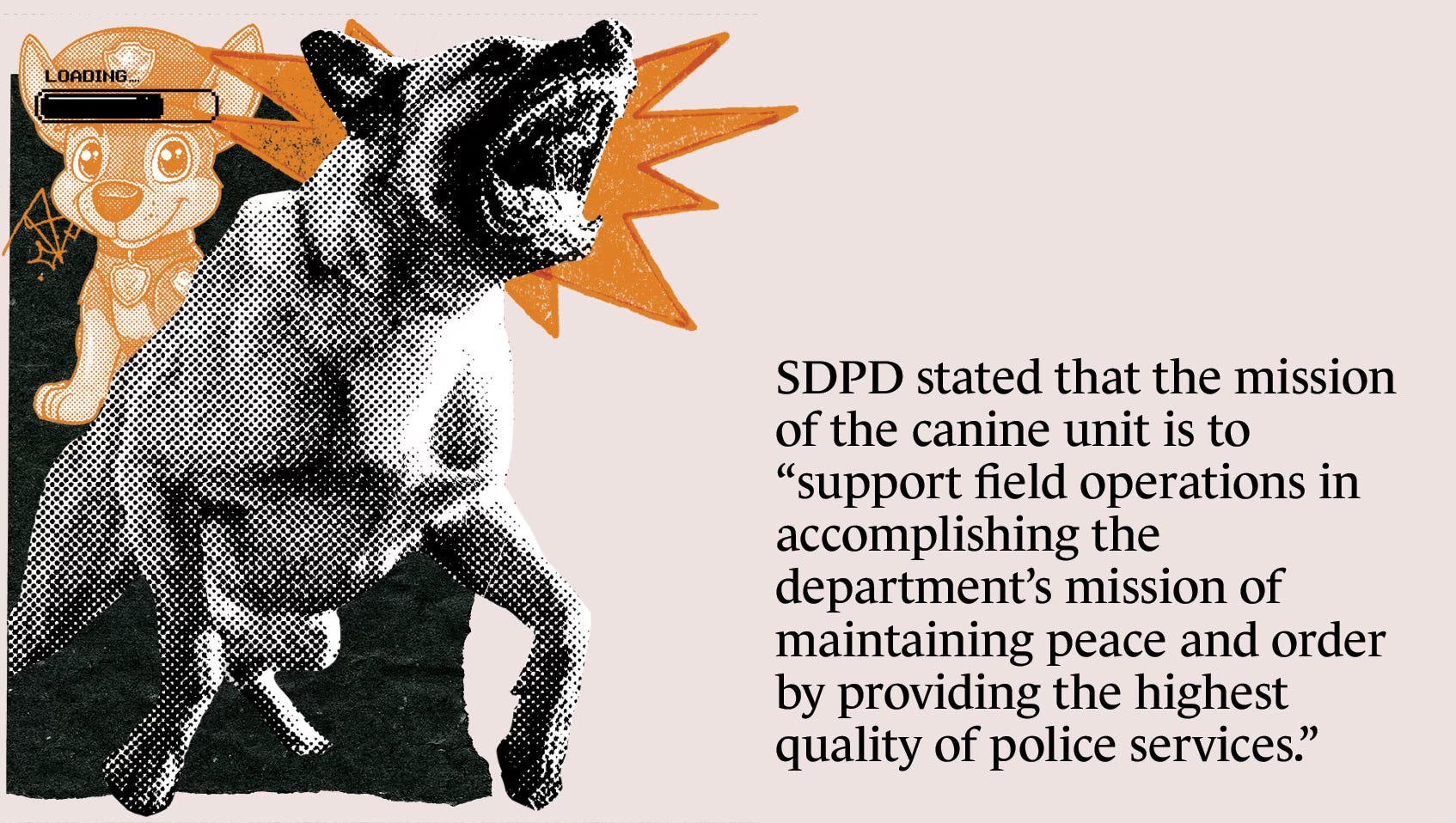
In December 2024, SDPD presented at the CPP meeting regarding the use of K9s. SDPD stated that the mission of the canine unit is to “support field operations in accomplishing the department’s mission of maintaining peace and order by providing the highest quality of police services” and argued that the use of the K9 unit is “an invaluable tool in the rapid detection of suspects, safer apprehension of suspects and provides deescalation.” The factors used to identify K9 selection include: high drive, social temperament, cognitive abilities and environmentally sound. SDPD states that canines are primarily used as a locating tool and are used to search areas, buildings, vehicles and evidence. SDPD further argues that because a canine’s sense of smell is 10,000 times greater than a human’s, “that’s what makes them good at what they do.”
Contrary to what is widely represented by law enforcement and television, the use of K9s is not a necessary law enforcement tool, nor is it particularly effective. In fact, studies have revealed that drug-sniffing dogs often produce false positives, particularly when searching vehicles or outdoor areas. Most disconcertingly, all too often police dogs do not respond immediately to commands to stop biting, and instead, continue mauling people for minutes after an individual is subdued, causing severe injury. Studies show that, because of their training, police dog bites are much more serious than ordinary dog bites and more often result in hospitalization.
According to the Marshall Project, police dog bites are the cause of more emergency room visits than any other kind of police force. In 2019, researchers at Riley Children’s Hospital in Indianapolis, Indiana conducted a study examining 32,951 emergency room visits, between 2005 and 2013, due to police dog attacks and found that the vast majority of the victims, 42%, were Black.
So while slavery has technically been abolished, the historical use of the “badges and incidents” of slavery permeates throughout the criminal legal system and modern day policing. The malicious use of police dogs perpetuate the state-sanctioned violence that continues to racialize and weaponize “man’s best friend” against the Black community.