

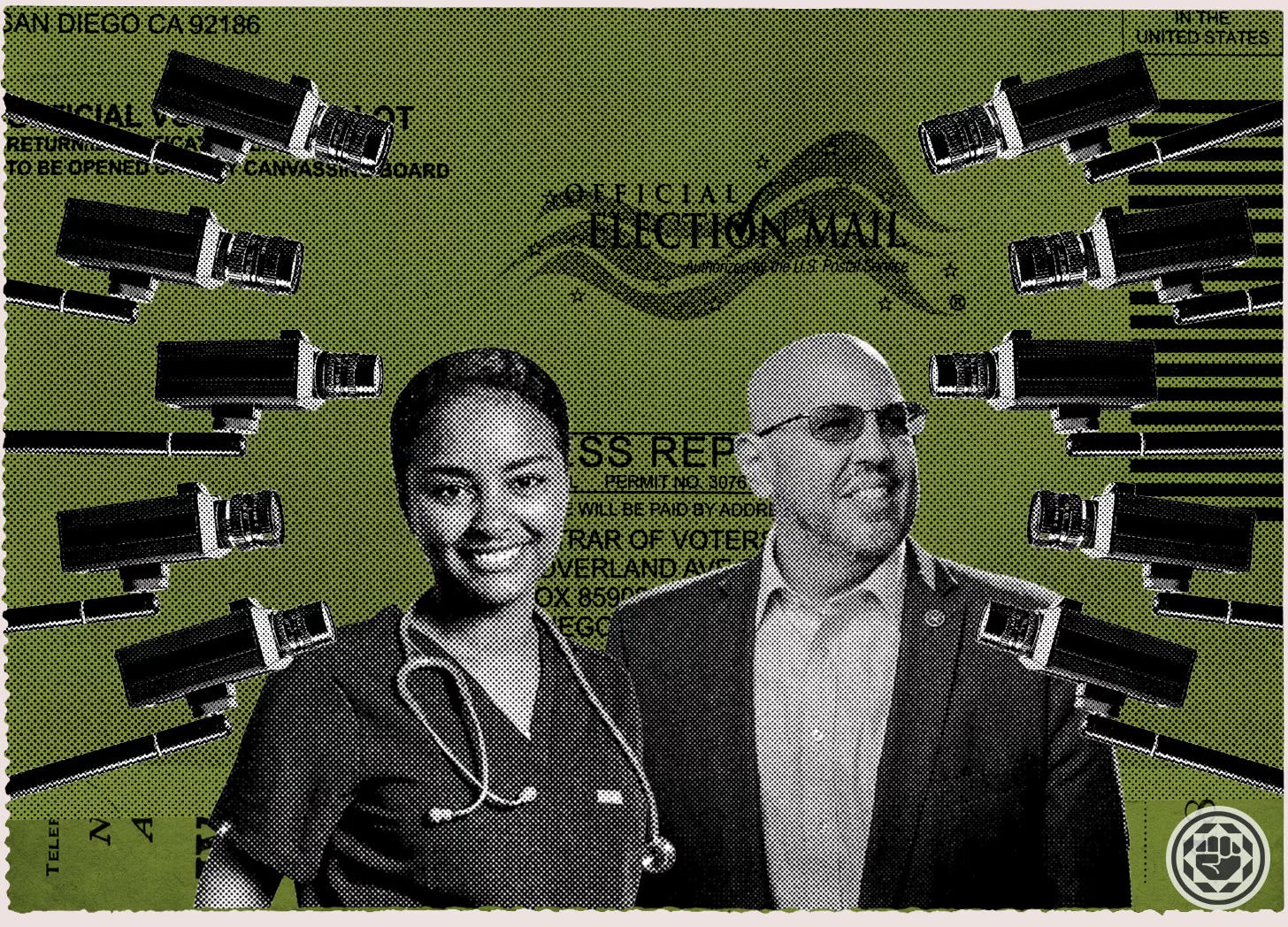
San Diego City Councilmember Stephen Whitburn’s Oct. 13 announcement that he no longer supports the police department’s partnership with an automatic license plate reader company could tip the scales politically.
Whitburn’s call to “turn off the cameras and cancel the contract” raises the stakes in the District 4 election. The future of Flock Safety in San Diego may depend on who gets elected in Southeast.
What is Flock?
Flock Safety is a surveillance system company, known for selling their automated license plate readers to police departments across the country. For years, reports have shown police officers abusing ALPR databases for stalking exes, illegitimate searches and illegally sharing data with outside agencies. ALPRs have even led to the wrongful arrest of two people in San Diego, according to Times of San Diego.
Incumbent City Councilmember Henry Foster voted against funding for Flock in June at a budget hearing and has been critical of surveillance technology in historically Black neighborhoods. Foster sits in the chair formerly held by Monica Montgomery Steppe, and in his former role as her chief of staff, helped oversee the creation of a citywide surveillance ordinance and privacy advisory board.
Still, the funding for ALPRs was pushed through by a 5-4 vote this summer — but that was before Whitburn switched sides. The city’s relationship with Flock could come up again in December.
Foster’s opponent, Martha Abraham, a nurse, has said almost nothing about police surveillance. In a recent social media post, she disavowed claims circulating in D4 that she’s “pro-Flock” but didn’t expound on the topic.
City Council District 2 on the coast is also a wild card. Jen Campbell, a Flock proponent, is termed out, and Democrat Nicole Crosby appeared alongside Whitburn when he made his statements to the press. Richard Bailey, former Republican Coronado mayor turned independent, has advocated against an immediate end to the relationship and also left open the question of where he actually stands on Flock.
Because he’s already a public figure, Foster’s position on Flock is easy to find. At a rally last year, he called for ending the relationship with Flock but left open the possibility of the city partnering with a different company — “a vendor that respects our residents,” according to KPBS.
In an interview on Oct. 17, Foster identified mass surveillance and overpolicing as serious concerns, not just locally but nationally. He promised to take action, along with his Council colleagues, “as soon as possible” to begin the process of shutting Flock down. His time on the Commission on Police Practices, where he helped implement recent reforms, also taught him that the department lacks accountability and that the increased money spent every year on the police budget should be reinvested in city services and public spaces for youth and other community members.
“When you look at everything happening, it comes down to simple calculations of what is right and wrong; this is about justice and standing up for what is right,” he said.
Abraham’s campaign website, by contrast, says nothing about law enforcement or automatic license plate readers. When asked for her personal opinion on Flock at a community coffee on Oct. 17, Abraham declined to offer one. She said she wants to represent everyone, and some people like it and some people don’t.
“It’s not about my opinion,” she said. “I want to make a decision based on evidence rather than emotion.”
When also pressed about law enforcement in D4 and the city’s growing police budget, Abraham acknowledged that she’s been racially profiled herself and advocated for better dialogue with police so that officers can “humanize” D4 residents.
“I am willing to work with the community to create a safer environment for all of us. That looks different for everyone,” she said. “You’re saying you don’t want the police but my neighbors say they do.”
She also said she favors mental health clinicians responding to more calls, but sounded hesitant to support cuts to the police budget in general. She argued that the Council would need five votes total to do that now, and the moment for change was in 2020.
“It wasn’t successful during the George Floyd movement and that’s the biggest time that that opportunity was there, and Monica Montgomery (Steppe) was at City Council,” she said.
Instead, Abraham has identified parks and the environment, infrastructure and economic opportunity — including more “public private partnerships” and city contracts for D4 residents — as major areas of interest. Publicly, she’s been most vocal about densification and subsidized housing in southeast San Diego, and she’s advocated for the (successful) repeal of a zoning change that reduced the minimum lot size for single-family homes in historically Black neighborhoods.
But while Abraham and her supporters have portrayed her as an anti-establishment candidate, online she’s touted her endorsement from the San Diego Chamber of Commerce — an organization that includes some developers and that has been an influential player in local politics for decades.
As Voice of San Diego recently reported, “Abraham’s messaging has focused on empathy, integrity, transparency and accountability — rather than specific goals.” Mayor Todd Gloria has reportedly told others that removing Foster from office is his No. 1 political priority in the upcoming election.
Nationally, and not just in San Diego, the politics of ALPR technology is shifting. Democrats and Republicans in Congress have introduced separate bills that, though they differ in some key aspects, would rein in the federal government’s use of ALPRs. The more progressive of these bills — spearheaded by Sen. Bernie Sanders of Vermont, Sen. Jeff Merkley of Oregon and Rep. Alexandria Ocasio-Cortez of New York — is called the Ban the Flock Act.
The pushback is stemming from years of reporting and research showing that local license plate data has been abused or shared with federal immigration authorities or led to the false arrest and imprisonment of drivers and passengers because either the machine made a mistake or the officers misread their own devices.
Last month, Times of San Diego reported that SDPD officers had searched their ALPR database nearly 115,000 times in 2026. The most common reasons for the searches were listed as stolen vehicles, arrest warrants, or weapons offenses. However, nearly 4,000 of those searches were merely listed as “other.”