

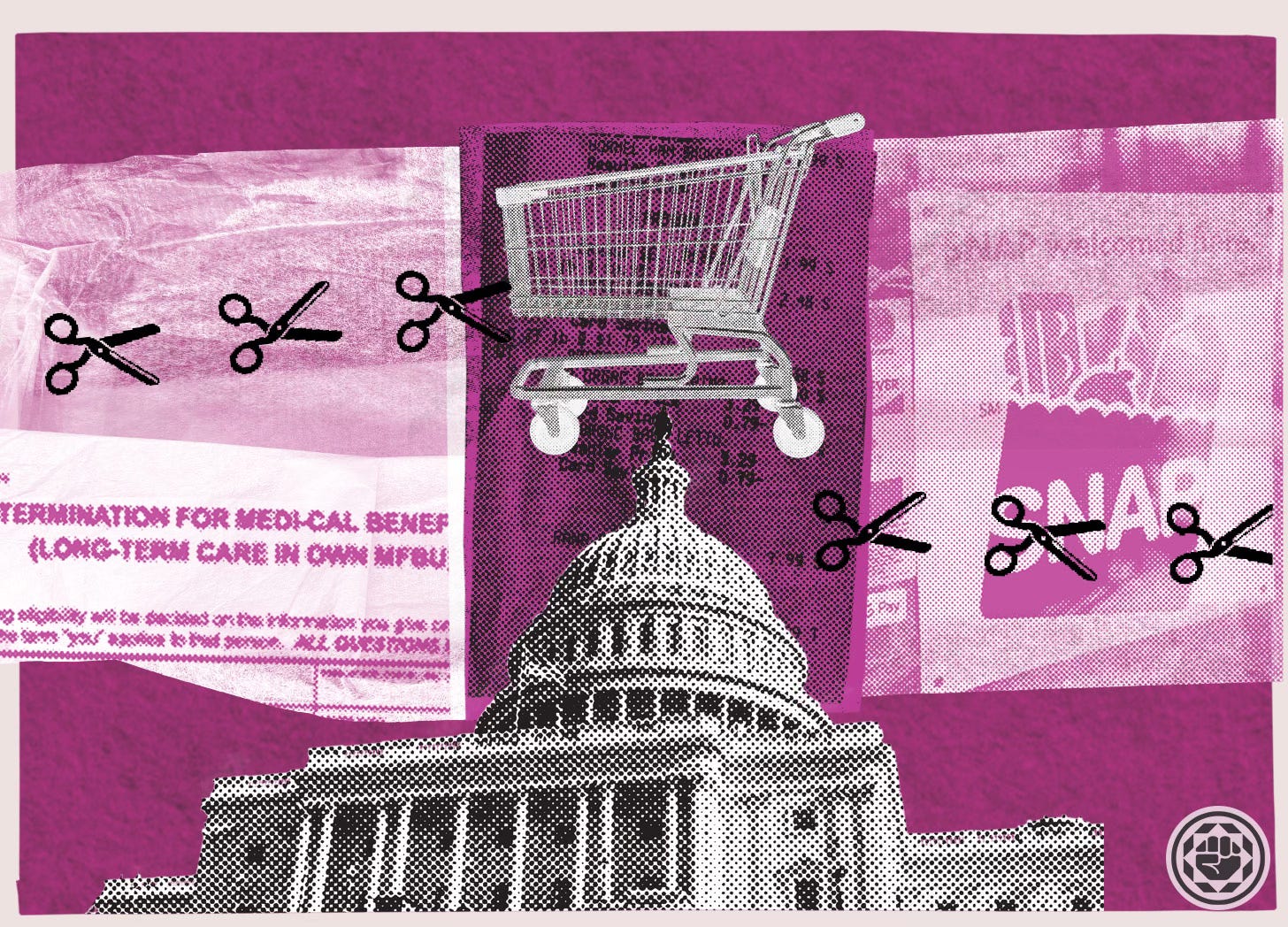
The passage of the “One Big Beautiful Bill” is being promoted as a bold new direction for the country: one that supporters claim will strengthen the economy, reduce government waste and redirect funding toward infrastructure and job creation. But for millions of low-income families, students, seniors, and working-class residents, the reality will be far more devastating. Behind the policy language are new barriers for communities to meet their most basic needs: food, medical care, and stability.
At its core, the bill restructures how Medicaid and the Supplemental Nutrition Assistance Program (SNAP) are funded and accessed, narrowing eligibility and increasing governmental requirements. While lawmakers insist these changes will create efficiency, critics argue that they instead strip essential resources from those who rely on them to survive. Under this legislation, SNAP eligibility will be recalculated, pushing many working families slightly above the income cutoff. Medicaid recipients will face stricter work requirements and more frequent eligibility checks. Even though 92% of adults enrolled in Medicaid already work or qualify for existing exemptions, the proposed changes could still result in 10 to 15 million people losing their coverage, according to reporting by The Intercept.
“SNAP doesn’t just provide food for students but they also provide stability and support for those in need. In today’s media, there is a lot of misinformation about SNAP, who it helps, and how benefits are used,” said San Diego college student Mumtaaz Elmi. “The reality is that SNAP helps students stay nourished, focused, keep grocery prices more stable, and supports local businesses to rely on consistent customers.”
Nationally, over 41 million people depend on SNAP and more than 71 million rely on Medicaid. In San Diego County, more than 391,653 residents use CalFresh and more than 860,000 rely on Medi-Cal. Statewide, as many as 3.4 million Californians may lose access to these life-sustaining supports. These aren’t abstract statistics; they represent neighbors, parents, youth workers, caregivers, and students striving for a better future.
How This Impacts Students and Youth
Students already navigating full-time coursework, part-time jobs, transportation costs, and rising rents rely on SNAP to maintain their energy, mental health, and physical well-being. Without it, survival becomes a daily calculation that competes directly with academic success.
Elmi said SNAP has been crucial to her ability to stay enrolled.
“Without SNAP benefits…I would have to spend more of my time figuring out how to make meals stretch or skip meals entirely,” she said. Being able to stay alert during lectures, completing assignments on time, and having the energy to participate in class would all become harder for me.”
For commuter students, especially those without on-campus housing or meal plans, SNAP is often the only accessible pathway to consistent nutrition.
“Access to SNAP allows me to afford groceries and prepare meals that help me through my long weeks at school,” Elmi said. “As a commuter student, a meal plan isn’t included in my financial aid package, so paying for one out of pocket would add an extra expense and reduce my financial aid.”
Beyond hunger, students emphasize that SNAP provides a sense of dignity, stability and safety, something often lost in policy debates dominated by stereotypes and misinformation.
Community Impact and Response
For families already living paycheck to paycheck, the consequences of these cuts are immediate and deeply felt. SNAP often determines putting dinner on the table or skipping meals, while Medicaid ensures access to preventative care and costly medical emergencies. Without these programs, families will be forced into heartbreaking choices between food, medication, rent, transportation, and safety.
Advocates from We All We Got, a local mutual aid organization, say the bill exposes just how vulnerable families are to sudden policy changes. “This bill is a reminder that we can’t always depend on the government and certain programs to support us,” said Krystle, an organizer with the group. “It’s really important at this point to reach out to your neighbors and support each other.”
They warn that this moment highlights a painful truth: decisions made from afar can quickly destabilize the lives of ordinary people. According to reporting from Truthout, annual Medicaid cuts under this bill could reach $70 billion, an amount comparable to the tax benefits the wealthiest Americans stand to gain. The issue is not simply balancing budgets, but reshaping who is allowed to thrive and who is left behind. To best prepare and adapt to these changes Krystle recommends ensuring SNAP documentation and eligibility paperwork are current to avoid disruptions in benefits.
As government support shrinks, mutual aid groups continue to pools their resources. Food distribution groups such as Shared Plate (North County), Lunch at the Park (Chicano Park), We All We Got, and other resources can be found by dialing 211.
Active Food Distribution Groups in San Diego
Verified at the time of publication. Check each organization to confirm dates and locations.
Shared Plate
209-231 N Quince St, near Escondido Transit Center
Thursdays 7:30-10pm
Lunch at the Park
Chicano Park
Sundays 12:30pm
We All We Got
The Brown Building at Azalea Park
Second and fourth Saturdays 12pm
I Am My Brother’s Keeper
6601 Imperial Ave in Southeast
Tuesdays 1-2:30pm
The “Big Beautiful Bill” claims to reshape the future, but for many, that future is one marked by scarcity, stress, and preventable suffering. Progress cannot be measured only through budgets, tax savings, or construction projects. It must be measured by whether people can still eat, heal, learn, and live with dignity.
Policies are not just numbers. They are someone’s dinner tonight, someone’s medication tomorrow and someone’s education for a lifetime.