

In recent years, residents of Southeast San Diego have raised concerns about a policing practice that disproportionately affects Black and Brown communities: traffic stops for window tint violations. A recent investigation conducted by Pillars of the Community, based on data from a California Public Records Act request to the San Diego Police Department, shows an unmistakable racial bias in stops made for window tints. The data indicates that these stops are overwhelmingly used against Black and Brown drivers, while white drivers are far less likely to be cited.
Pretextual stops for things like window tints are legal under both federal and California law. The U.S. Supreme Court, in cases such as Whren v. United States in 1996, has repeatedly held that officers can stop a driver for a minor traffic violation even if their true motive is to investigate something unrelated. California courts have found the same thing. In People v. Superior Court (Briggs), the state’s high court affirmed that officers can stop vehicles for minor violations regardless of motive.
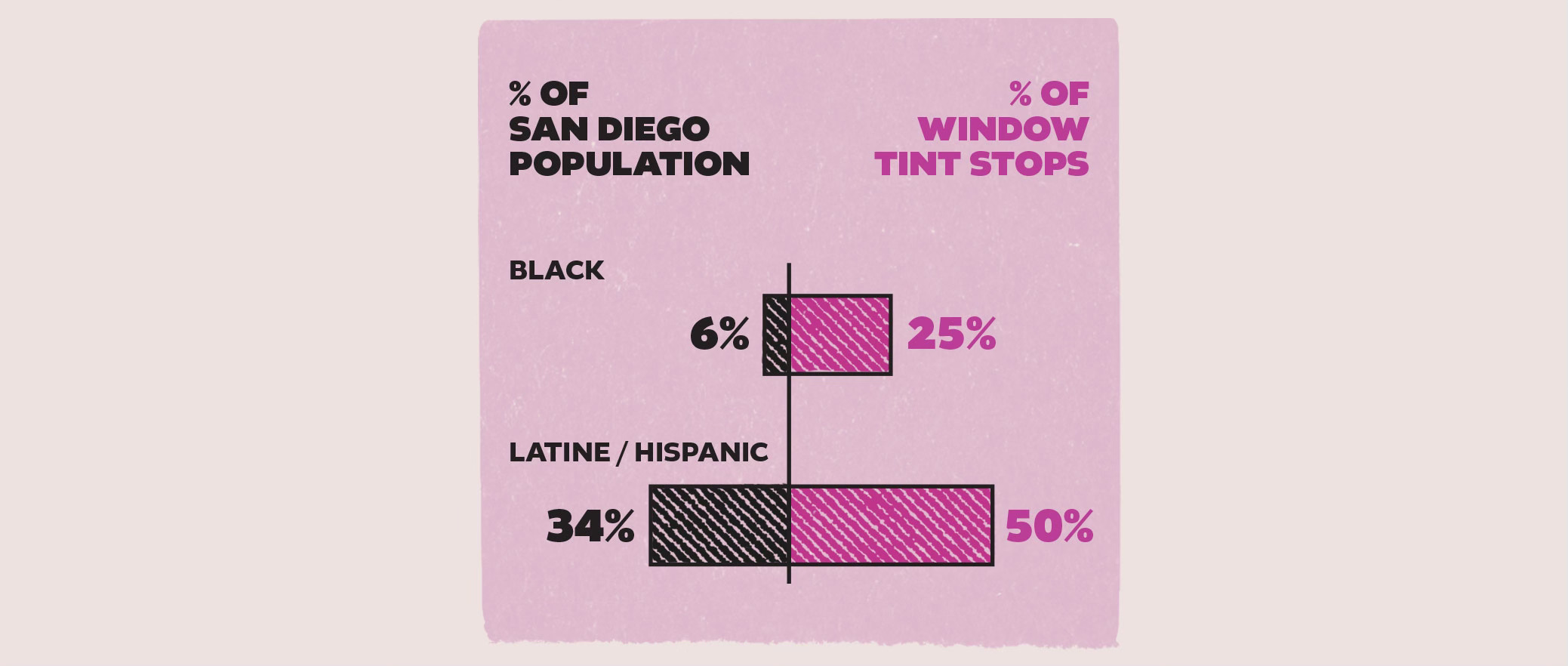
Even though it’s legal, civil rights experts say that pretextual stops create fertile ground for racial profiling. Alexes Harris, a sociology professor at the University of Washington, notes in a 2021 article for Vox, “The problem with pretext traffic stops is that when police use their discretion to decide who to pull over, they disproportionately pull over Black drivers more than white drivers…The practice of pretext traffic stops allows police to surveil communities of color, over-patrol them, and pull people over.” The San Diego Police Department’s own data appear to reflect this pattern. Preliminary findings from the Pillars investigation show that Black and Latino drivers were disproportionately cited for window tint violations compared to white drivers, demonstrating that enforcement is not equally applied in Black and white communities.
For residents of Southeast San Diego, the impact of pretextual window tint stops is far from abstract. Drivers report feeling singled out and harassed, and community members have to deal with the stress and anxiety that is produced from over policing in our communities. Local community advocates emphasize that these stops have cumulative consequences: fines, court appearances and sometimes even vehicle searches that can lead to criminal charges. While the law permits pretextual stops, the disproportionate application against Black and Brown residents points to systemic inequities that undermine community trust and safety.
Some city officials have acknowledged these concerns. County Supervisor Monica Montgomery Steppe said, “The data from all reports, including the recent report from the Center on Policing Equity, highlight the shameful reality that Black San Diegans and other members in our communities of concern face inequitable treatment from law enforcement,” when she was a city councilmember representing District 4. The San Diego Police Department insists that traffic enforcement will promote safety and compliance with the law, though the department has not addressed the apparent disparities in tint violation stops.
The pattern in San Diego mirrors a broader national trend in which pretextual stops are employed unevenly. Civil rights and community advocacy organizations emphasize the need for transparency, data tracking and accountability mechanisms to prevent misuse. In the local context, residents of Southeast San Diego are uniquely positioned as both the most affected and the most knowledgeable about the daily realities of biased enforcement that happens in their community.
Community members are encouraged to document encounters with police, participate in local forums and engage with organizations like Pillars that are monitoring policing practices. By speaking out, attending city council meetings and supporting policies that ensure equitable enforcement, residents can push for systemic changes that protect their rights and their community from rogue over zealous cops.