

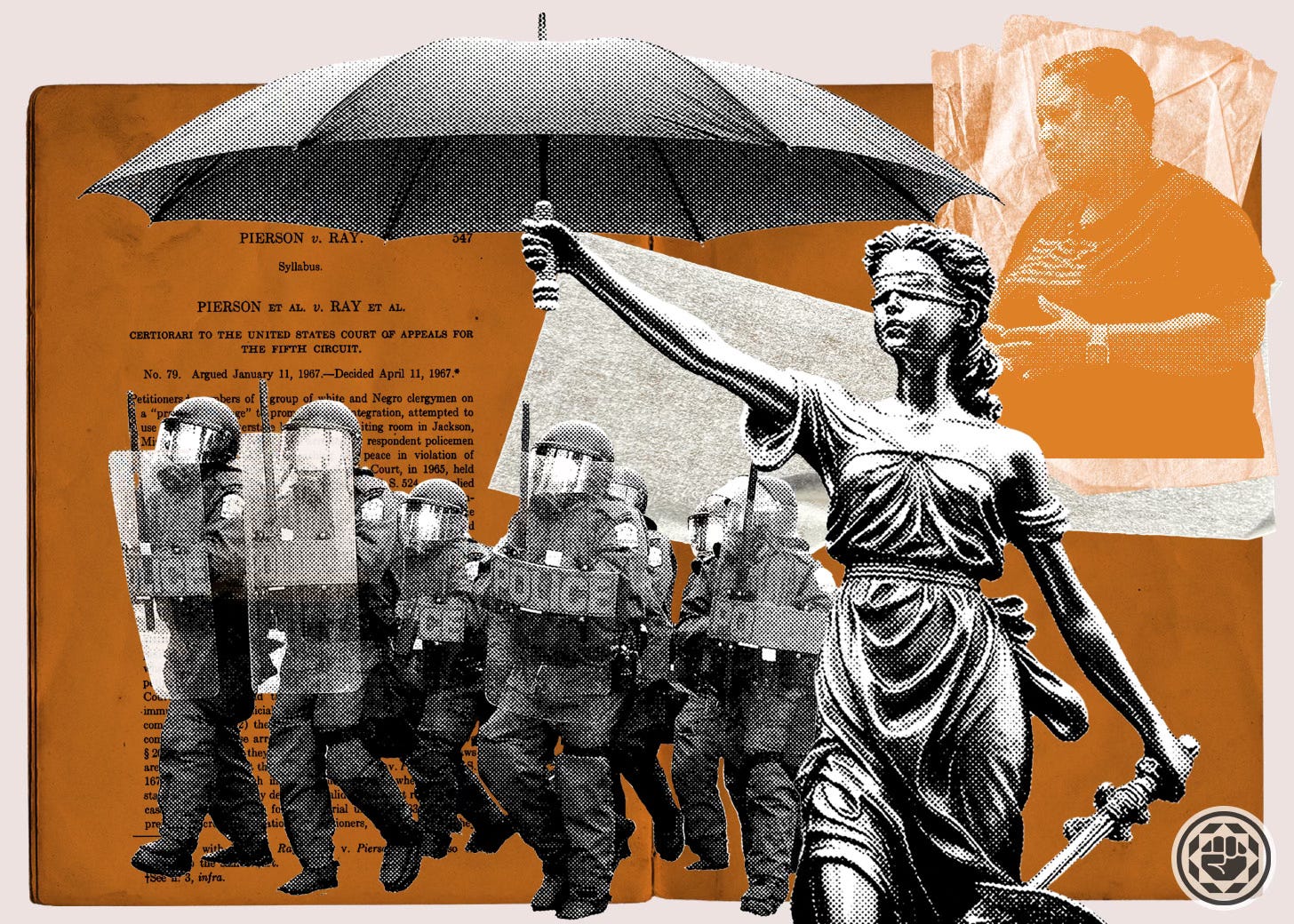
We need only to look at the case of Tasha Williamson to see just how insidious and subjective the Qualified Immunity regime is. As a legal doctrine, Qualified Immunity sets an extremely high bar by protecting police and other government officials from being held personally liable for violations of constitutional rights unless the violation was “clearly established” at the time of the incident and a court has previously said that the conduct was wrong.
In 2018, Williamson, a community activist, organized a direct action against City Council of National City following the death of Black man while in police custody. It was an action which she and her cohorts preplanned and knew to be unlawful. While they had made plans and provision to be arrested and jailed as a part of their civil disobedience, Williamson didn’t plan on being the subject of excessive force that left her with life long injuries, and she certainly didn’t plan on the officers who abused her being given a pass against civil suit by way of Qualified Immunity. Nor had she planned on being physically assaulted while the white women who protested right alongside her were treated humanely during their arrest.
Even as her abuse was caught on tape, Williamson was not entirely convinced that filing a federal lawsuit would result in justice. “When I filed my federal civil rights claim, I had hoped the legal system would acknowledge the injustice I endured and hold those responsible accountable,” she said. “The legal system has historically protected officers, often at the expense of the rights of community members, historically harmed by police officers. While I pursued the case to expose the wrongdoing and seek accountability, I understood that justice was not always guaranteed, especially when facing deep systems of protection for law-enforcement.”
She went on to say that “qualifying immunity is a deeply flawed legal doctor that shields police officers from accountability even when they violate people’s constitutional rights. They create an environment where officers feel emboldened to act with impunity, knowing that legal repercussions are unlikely.”
As with nearly every case that involves the expansion of police powers, the question of “Qualified Immunity” was decided at the intersection of race and policing. When police powers are expanded this happens almost always from the bench, where judges decide that the U.S. Constitution needs to be limited or restricted in ways that allow police officers greater latitude to “do their jobs”. As has been pointed out many times before, most judges are white men, many of whom at one time in their lives used to be prosecutors. According to the Cato Institute as of April 2021, 318 former prosecutors were sitting as federal judges, more than one-third of the 880 total across the country.
In 1967, in the heart of the tumultuous Civil Rights Era, police and other agents of the state were increasingly facing challenges in courts across the country as it related to the treatment of citizens by government officials. The nation was still struggling with the notion of inclusion and full participation on behalf of all its citizens and police had a particularly difficult time restraining themselves from legal over-reach which had historically been commonplace with respect to the “rights” that Blacks and other minorities had. There were a series of cases that wound their way through the courts, nearly all of which were decided in ways that expanded the powers of law enforcement while narrowing the ability of citizens to use the courts to check
police power.
Qualified Immunity arises from one such case (Pierson V. Ray). Time and space don’t allow for an analysis of that case; suffice it to say, in 1967 police arrested, beat and jailed peaceful civil rights activists and were told, by the Supreme Court, that their conduct was immune from suit because they were “acting in good faith.” Thus was born this insidious and dangerous doctrine of Qualified Immunity for police officers.
Local civil rights and criminal defense attorney Dante Pride has had many cases involving police misconduct and is always fearful that even the most obvious case of police abuse will be dismissed because of qualified immunity.
“I had a case against a police force that I thought they were going to [file for qualified immunity], but we had them. Officer was in a riot situation, but it was calm, he was shooting a gun that wasn’t from his department, not wearing his regular uniform. Aimed at this woman’s face and not her torso like protocol. And they didn’t file for Qualified Immunity for that one. It was painfully obvious. I thought they were going to say it was a riot situation in gear he had never used before. But that’s a good microcosm of qualified immunity. He shouldn’t have had the rifle, aiming the rifle, shot the rifle, but I was still concerned that qualified immunity was going to rear its ugly head.”
That we have bands of armed government agents who have been given near carte blanche to create new and previously unchallenged ways to harm citizens and community members is painfully clear. This phenomenon is particularly concerning to community members who have historically been the victims of police violence and overreach. In many cases the courts deny victims of police violence the ability to recover monetary damages from officers who bring immeasurable harm to communities of color; furthermore, district attorneys have, in most cases, declined to file criminal charges against police. Unless and until qualified immunity is removed from the toolbox of law enforcement we will be witness to this continuous cycle of cops harming community members with little or no recourse left to them besides complaining in quiet circles to people who need no convincing that police are out of control and unaccountable.
There is a nationwide movement to curtail this court-created doctrine. Organizations like Legal Defense Fund operate a “Qualified Immunity Working Group” to fight in federal courts, the ACLU advocates against the doctrine in state and federal courts, the Innocence Project promotes ending the doctrine because of the impact it has on wrongful convictions, and Institute for Justice challenges the doctrine with their “Project on Immunity and Accountability.” All are at the forefront of the fight to end this legal loophole for police.
Citizens who are concerned about unaccountable police and the overbroad policing that happens as a result can demand from their elected officials that they pass legislation to eliminate Qualified Immunity and thereby eliminate the ability of police officers to violate citizens rights without accountability. Ridding our communities of the scourge of Qualified Immunity is a difficult and uphill battle; as a practical matter if the Supreme Court doesn’t reverse itself, the legislatures, state and federal, will have to act to end this practice. ALWAYS FILM THE POLICE!