

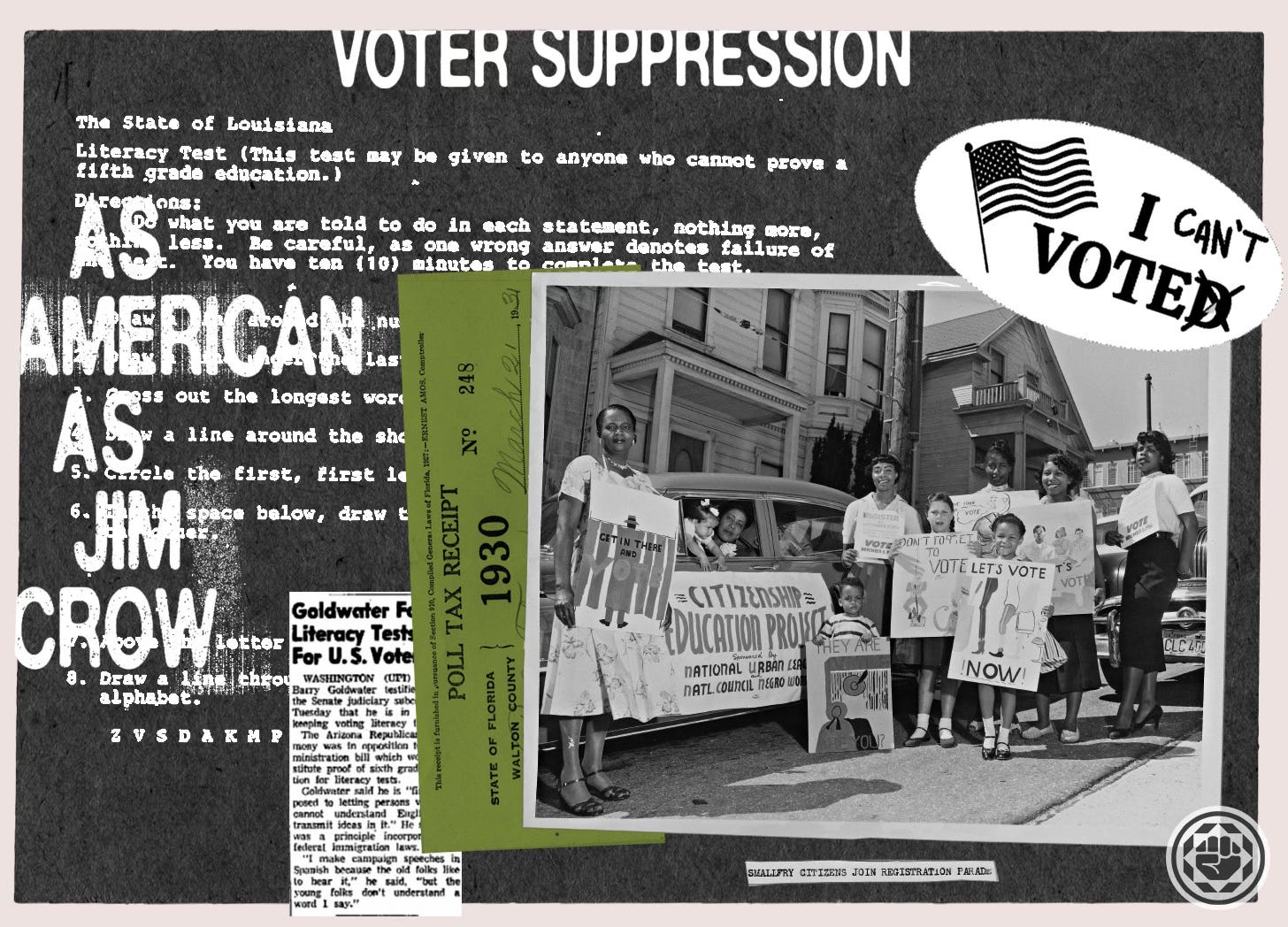
A Midwestern billionaire and a horde of venture capitalists in the Bay Area are teaming up with San Diego real estate developers to make voting harder.
If it passes in November and amends the state constitution, Proposition 39 would require Californians to present a government-issued ID when voting in person or provide the last four digits of an ID when voting by mail on the outside of the envelope.
The ballot measure would also require election officials to “maintain accurate voter registration lists” and report the percentage of voters on every county voter roll who’ve been verified as citizens. Additionally, the state auditor would be required to report “findings and recommendations for improving the integrity of elections to the public” every two years.
Opponents argue that Prop 39 would most likely end up disenfranchising formerly incarcerated people and immigrants, and the Legislative Analysts’ Office estimates that the initiative would increase state and local government costs each year by tens of millions of dollars.
The sides are being drawn in a predictably partisan fashion, with conservatives framing the initiative as a common-sense way to “restore public trust and confidence” in the electoral system. Progressives, on the other hand, point out that conspiracies of widespread voter fraud have no basis in reality.
Prop 39, the ACLU of Northern California posted on social media, “claims to solve a problem that doesn’t even exist.”
Purporting to be a citizen when you’re not, or impersonating another person at the ballot box, is already a crime, and numerous studies and reports in recent years have concluded that voter fraud is so rare that it is statistically insignificant. Even the most generous estimates of fraud put the total rate of fraud at less than one-hundredth of a percent point — representing a few dozen instances, over decades, out of billions of ballots cast. Groups like the Brennan Center for Justice have found that most reported incidents of voter fraud are actually traceable to “clerical errors or bad data matching practices.”
Faced with this extensive research, the Prop 39 campaign has distanced itself from President Donald Trump in Democrat-dominated California and framed its efforts as nonpartisan and technocratic. For example, former California Secretary of State Bill Jones, one of the ballot measure’s supporters, has acknowledged that voter fraud is not rampant. Instead, his pitch to California voters is that “the system has fewer checks than it used to, at exactly the moment public trust in institutions is at a low ebb.”
In response, opponents of Prop 39 have argued that while public trust in democratic institutions is indeed waning, the additional checks on an already-secure system have nothing to do with security.
Jose Lopez, director for the San Diego office of the Alliance of Californians for Community Empowerment (ACCE), acknowledged that there is plenty of mistrust in the two-party system and politicians broadly speaking. “But they’re trying to control the narrative. They want you to believe undocumented people are voting and they say something so much that it starts to sound like the truth,” said Lopez, who’s running for the Imperial Beach City Council.
In a statement, Jenny Farrell, executive Director of the League of Women Voters of California, framed her opposition in light of Trump’s ongoing, baseless claims that the 2020 election was stolen: “This voter ID measure is not about protecting voters; it is about importing the current federal administration’s election lies and intimidation tactics into California.”
The New York Times also reported in September that the Trump administration deployed hundreds of Department of Homeland Security agents to look for noncitizens among registered voters nationwide in state-managed voter rolls.
The Golden State is not the only site of this political dispute. This fall, according to the California Budget & Policy Center, voters in five other states will consider measures to impose stricter voter ID laws. This year alone, the nonprofit research group’s analysis found, eight states have approved more stringent requirements, and Oklahoma enshrined a voter ID requirement in the state constitution. In 2025, at least 17 states enacted laws restricting voting rights.
Many of these laws, or proposed laws, require documents that large swaths of the population do not possess. For example, research by the Brennan Center for Justice shows that roughly half of Americans don’t have a passport, and millions lack access to a paper copy of their birth certificate.
The group behind the initiative here, Californians for Voter ID, has raised about $15 million, more than a quarter of which came from a single person — Richard Uihlein, the 80-year-old billionaire from Pleasant Prairie, Wisconsin, who currently lives in Illinois. He’s heir to the Schlitz brewing fortune and founder of a private shipping supply company.
The Uihlein family has long been a political force on the right. Richard’s father was a high-ranking member of the ultraconservative John Birch Society and supporter of segregationist presidential candidate George Wallace in the ‘60s and ‘70s. Richard Uihlein has also reportedly backed election deniers for political office since 2020 and was a major contributor to the rally that preceded the Jan. 6 Capitol riot in 2021.
Other major donors to Prop 39 include venture capitalist Tim Draper, who’s tried to break up California into multiple states, as well as two employees of Silicon Valley’s Sequoia Capital and the Winklevoss twins, known for their crypto investments and for alleging, unsuccessfully in the courts, that they invented Facebook. Local donors include former Union-Tribune owner Doug Manchester, real estate developer Thomas Sudberry and Republican State Assembly member Carl DeMaio’s Reform California.
“Reform California is pushing this onerous policy to revive regressive laws not seen since the Jim Crow era,” said Ludovic Blain, CEO of the California Donor Table, in a statement.
As they and others have pointed out, Californians are already required to state under penalty of perjury that they are U.S. citizens and provide information to verify their identity and the voter ID requirement would disproportionately impact Latino adults and young people. Surveys show that about one in four Latino adults don’t have a driver’s license showing their current name or address and the same goes for approximately 40% of young people.
The opponents also argue that another barrier to voting would fall hardest on Californians with disabilities, expose sensitive personal information and create new ways to toss out eligible ballots or disenfranchise others.
Financial opposition to the initiative is primarily coming from the ACLU of Northern California and California Donor Table, which pools money from liberal organizations. Major labor groups representing nurses, teachers and service workers are also opposed.
States have the exclusive authority over their voter rolls. But as ProPublica and The Texas Tribune reported earlier this year, a Department of Homeland Security tool known as SAVE, used mostly to check immigrants’ eligibility for public benefits, has dramatically expanded during the second Trump administration to include voter data shared by Republican secretaries of state. In trying to mass-verify who was and wasn’t eligible to vote, the tool misidentified some voters as noncitizens in at least five states.
A nationwide version of the program, called the SAVE America Act, passed the House but stalled in the Senate earlier this year. Historian Carol Anderson described these efforts as a modern form of Jim Crow and the federal legislation specifically as “a voter purge bill dressed up as security.”