

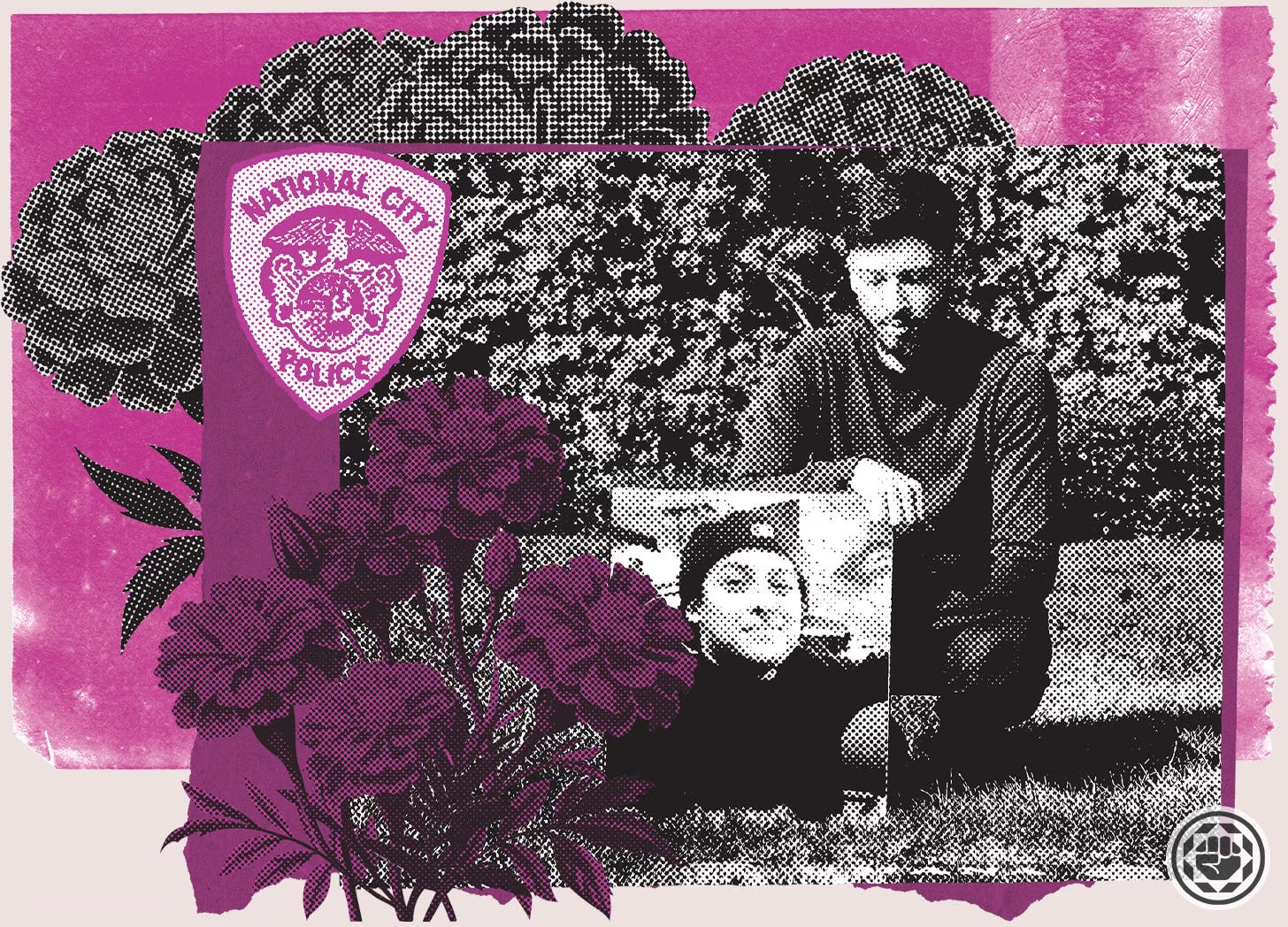
On a warm autumn afternoon, Roberto Umana walks the grassy lawns of El Camino Memorial. It’s a quiet cemetery, a solemn place adorned with wreaths and bouquets tucked behind Cypress View Mausoleum that he has become all too familiar with. Every week, he visits to change the flowers at the grave of his older brother Brian Umana, who was killed by the National City Police Department while in the midst of a mental health crisis four years ago.
In the early morning hours on a rainy October 8, 2021, the police department received a 911 call reporting a man armed with a machete who had tripped an alarm and allegedly attempted to break into a self-storage facility.
The police found Brian Umana, a 28-year-old Latino man nearby, pacing barefoot in the rain, up and down the sidewalk on 33rd St. near National City Blvd. He was still holding the machete when National City police officers Evan Davis and Michael Sportelli, and Corporal Ryan Stinnett arrived on the scene. Within minutes, Brian Umana was dead, shot 8 times by the officers, including in the back, after he raised the machete as a police K-9 approached him. Davis and Sportelli opened fire on Brian Umana, using a handgun and an AR-15 rifle, respectively. Brian Umana was shot only seconds after Stinnett deployed a single taser round, according to a report released by the San Diego District Attorney, who declined to bring criminal charges against the officers.
Roberto Umana and his family didn’t receive confirmation of his brother’s fate until several days later.
Beyond National City, few know of Brian Umana. The case did not draw nationwide attention. However, Brina Umana’s death is only one of several fatal encounters in recent years involving the National City Police Department responding to people in the midst of a mental health crisis.
From the Documenters: This story came from notes taken by Stephanie Lao, a San Diego Documenter, at a City of National City - Boards & Commissions meeting in August 2025. The Documenters program trains and pays community members to document what happens at public meetings. It’s run by inewsource, a nonpartisan nonprofit newsroom dedicated to investigative and accountability journalism. Read more about the program here.
In 2018, Earl McNeil, a Black man, died in custody after officers placed him in a full-body restraint device to bind his arms and legs and placed a mesh face-covering known as a spit hood over his head. The following year, National City police killed a white man named Tony Wilson after officers pinned him to the ground and tased Wilson five times in the span of 40 seconds.
In all three cases, National City officials notably opted to pay the victim’s families to settle the lawsuits. McNeil’s case settled for $300,000, and Wilson’s settled for $350,000. Brian Umana’s wrongful death lawsuit was the largest. Earlier this year, National City agreed to settle the federal lawsuit for $1 million, the largest settlement amount for a wrongful death lawsuit in the city’s history. In their lawsuit, the Umanas said that the National City Police Department “used unreasonable and excessive force” during their interaction with Brian Umana.
“Instead of fully assessing and de-escalating the situation, Officers Sportelli and Davis brought out a threatening police dog and pointed their guns at Brian,” the lawsuit states. “Impatient with Brian’s aimless pacing and abnormal behavior, officers Sportelli and Davis ran towards Brian and sicced their police dog at him.”
All of the officers involved in Brian Umana’s death testified under oath that the department had trained them specifically that escalation was a de-escalation strategy.
For the general public, many were unaware of who Brian Umana was beyond the initial local media coverage. However, Roberto Umana says that police statements, sparse reporting, and the District Attorney’s letter fail to accurately describe who his brother was and truly detail the struggles that he had endured in the years leading up to his death.
Roberto described his brother as a normal, somewhat shy 28-year-old—a family man who took joy in spending time with his girlfriend and infant daughter. He enjoyed the outdoors, going to the beach, hiking, and collecting sneakers. Roberto Umana says that his brother suffered from bipolar disorder and schizophrenia, exacerbated by their father’s unexpected death in 2014. “Mental health was something that he was struggling with,” he recalled. “He literally saw our dad pass right in front of him. He just never really got over it…and ever since that day, he definitely was never the same.”
Following the settlement, the National City Attorney’s Office issued a statement claiming that the city’s decision to settle was “done to mitigate financial risk to the City and taxpayers,” dismissing the settlement’s indictment of the city and the National City Police Department’s response as “a reflection of the realities of our litigious society,” and that the city’s decision to reach a settlement was done to “mitigate financial risk to the City and taxpayers.”
Roberto Umana has been quick to push back on the City Attorney’s Office’s glib response. “It was never about money for us at all whatsoever,” he said. “It was about accountability and for them to own up to their wrongdoings, that’s all it was for us as a family.”
In fact, Roberto Umana says that he would have taken the case to trial if the decision were his. “If it were up to me, I would have gone all the way to trial. But it wasn’t up to me. My mother had the ultimate decision,” he said.
Following the settlement, Umana doubts whether the police department will make the necessary changes to prevent future fatal encounters with officers. The National City Community and Police Relations Commission was created to provide a “forum for citizens to voice their concerns and comments about police conduct, practices, and policies and improve communication between residents and the National City Police Department.”
For Roberto Umana and other residents critical of the city’s response, the commission has little to no sway in actually implementing policy reform. “I believe that having a commission looks nice on paper, but in reality, it lacks real authority,” he said. He cited a lack of websites, social media pages, or any contact information provided to the public as evidence that the commission has done little to even make itself known to the public. So far, he says he’s only found one instance where the commissioners attended city council meetings.
“The public just doesn’t know that this commission even exists,” Roberto Umana said. “I’ve gone to the Commission meetings before, and there’s no one there. It’s just me. At times, it’s just me and maybe one other person. Other than that, it’s just myself and empty seats.”
The commissioners did not respond to questions from All Rise regarding the commission’s frequency of meetings, nor did the National City Police Department respond to inquiries regarding whether the department had implemented new policies and protocols when responding to calls involving individuals in mental health crises. The department also did not respond to inquiries into whether it planned to revise training that teaches ‘escalation as a de-escalation’ strategy to officers.
Four years later, Roberto Umana still struggles with the loss of his brother. Brian Umana’s killers were never held accountable. In 2023, the San Diego County District Attorney cleared both Davis and Sportelli of any criminal liability in his death.6 Roberto Umana said that the toll of fighting for justice has been heavy, despite the settlement. And although the officers who killed Brian Umana were never held criminally responsible, Roberto Umana hopes that his groundwork can serve as a blueprint for families.
“It’s going to happen again here in National City. It’s inevitable,” Roberto Umana said, sighing. “They’re not doing anything to fix the situation. They’re just paying people out; they’re not implementing new programs or new training. They’re not firing officers who need to be removed – it’s going to happen because they’re not taking action to fix this problem. And hopefully, whenever this happens, God forbid, they’ll see my brother’s case and how I went about it.”
Roberto Umana said anyone can find themselves in the same situation that his family and many others have found themselves in. “If you don’t comply, you die. I think that’s the mindset that these officers have nowadays,” he said.
“I want people to know that my brother could easily be their relative,” Roberto Umana said. “I want people to know that this was a human being, and my brother deserves to be here right now.”
Roberto Camacho is a Chicano freelance multimedia journalist from San Diego, California. He is a graduate of the Walter Cronkite School of Journalism and Mass Communication at Arizona State University and Vice President of the local chapter of the National Association of Hispanic Journalists (NAHJ), San Diego/Tijuana chapter.
His reporting typically focuses on criminal justice reform, immigration, Chicano/Latino issues, hip-hop culture, and their intersections to social justice.